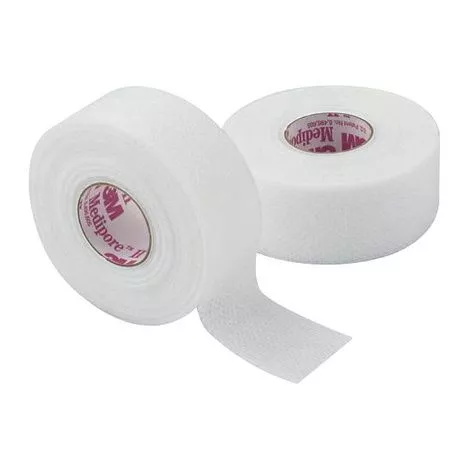
Features of Medipore H Soft Cloth Surgical Tape
- It is gentle and highly breathable soft cloth tape to maintain skin integrity
- Reduces the risk of skin irritation
- Can adhere with only finger or hand pressure
- Conformable with excellent bi-directional stretch to accommodate swelling and movement
- High adhesion cloth medical tape for a range of applications
- Adhesion builds over time, with the first 24 hours
- Perforated tape allows user to tear tape off the roll by hand
- 3M Medipore Tape prevents Medical Adhesive Related Skin Injuries (MARSI), which is the key for providing positive patient outcomes
- Easy to apply and remove
- Easy to handle, with or without gloves
- No curling or self-adhesion
- Economical and available in single-use roll
Indications
Medipore H Surgical Cloth Tape is used for dressing and device securement and indicated for following condition types:
- IV Related Condition Type: Arterial Catheter, CVC Implanted Port, CVC Dialysis, CVC Short-Term, CVC PICC, CVC Tunneled, Epidural Catheter, PICC
- Skin Care Condition Type: Trauma from dressings and tapes, Peri-Tube Skin Irritation and Trauma at Tracheostomy Site
- Wound Care Condition Type: Closed Intact Surgical Wound, Donor Sites, Laceration, Abrasions, Neuropathic Ulcers, Open Surgical Wounds, Skin Tear, Superficial Partial Thickness Burns, Venous Leg Ulcer
Suggested Applications of 3M Cloth Surgical Tape
- When repeated taping is required
- Securing ostomy pouches or dressings to fragile skin
- Securing over such areas where skin may stretch as in case of hematoma formation or movement, edema and distention
- Anchoring post-surgical dressings
- Used as retentive sheeting over gauze
Safe And Effectiveness
Safe as shown by:
- Human Repeat Insult Patch Testing
- Human Cumulative Irritation Patch Testing
Effective as shown by:
- Extensive tests on human volunteers
- Product evaluations in clinical settings
What to consider while choosing a tape for tube or dressing secural?
- Degree of importance of tube or dressing:
- The more critical the tubing/dressing, the higher the adhesion required
- Strength of adhesion and backing may be more important than gentleness
- Gentle tapes with higher adhesion may be used without increasing the risk of skin trauma if properly applied and removed
- Some tapes are less gentle but are used for high initial adhesion, high long-term adhesion and high strength of backing
- Surface characteristics:
- Heavy tubings require higher adhesion
- Bulky dressings require high conformability and may require greater adhesion
- Individual results may vary
- Skin:
- Dry, Damp, Diaphoretic
- Wet: secretions, leaking tubes
- Weeping, Macerated, Oily
- Dressing: Material, Weight, Conformability
- Device:
- Contour, Weight
- Material: metal, plastic, other
- Tubing:
- Diameter: small, large
- Texture: smooth, ribbed, other
- Material: PVC, silicone, other
- Weight, Length, Potential for drag or pull, Other support (e.g., sutures, tunneling)
- Activity level of patient: The more active the patient, the higher the adhesion required
- Potential for skin surface distention or movement: The risk of skin damage may be reduced by using tapes that stretch with skin distention or movement
- Anticipated wear time: Tape adhesion generally builds over time. Breathable tapes are used for longer-term wear
- History and current medical conditions: History and current medical conditions should be studied e.g., allergies/ sensitivities to medical adhesives, medications, medical conditions
Frequently Bought Together
- 3M Coban LF Latex Free Self-Adherent Wrap
- 3M Cavilon No-Rinse Skin Cleanser
- Smith & Nephew Uni-Solve Adhesive Remover
Why This Product Stands Out?
This product stands out for multiple reasons –
- It is soft and comfortable, gentle on skin with long-term structural integrity
- High adhesion builds over a 24-hour period, yet remains immobile during use
- Hypoallergenic and free of latex, making it safe to use on those with sensitive skin
- Provides a breathable, elastic quality to allow for changed in swelling and body movement as well as conforming to the body’s natural shapes
- Easy to tear off rolls and has many additional uses, such as IV line covering, surgical dressing, ostomy care, and protecting open wounds.
How to use 3M Medipore Tape?
- Tape should be applied without tension to clean, dry skin.
- A clipper may be used to remove hair, if necessary.
- To protect at-risk skin, 3M Cavilon No Sting Barrier Film may be applied and when thoroughly dry, the tape may be applied over it.
- In general, do not encircle a limb completely with tape.
- If distention is anticipated, use a tape that stretches or a self-adherent wrap to secure the dressing or tubing.
General Taping:
- Apply the tape without tension, gently but firmly stroking the surface to maximize adhesion.
- Tape should extend at least one-half inch beyond the dressing.
- Tape should not be pulled or stretched when applied.
- If swelling does occur, loosen and re-fasten or replace tape to relieve the tension.