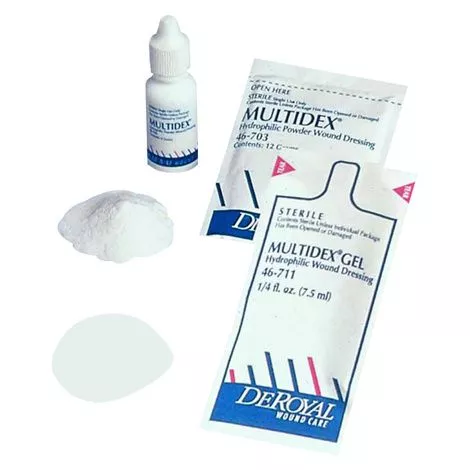
Features of Multidex Powder
- Clinically proven to maintain a moist environment beneficial for granulation tissue growth and epithelial proliferation
- Effective even in the hardest-to-heal infected wounds
- Softens necrotic tissue to facilitate debridement
- Specially formulated for the dry or minimally draining wound
- Controls odor, decreases the amount of purulent exudate
- Quickly fills wound site, rapidly mixing with the exudate to form a protective coating that maintains an ideal moisture balance to protect against dehydration
- Not systemically absorbed and primary dressing
- Wound Powder is non-toxic
- Works on infected wounds and cuts that are not healing properly
- For use on most wound types, including infected hard-to-heal wounds
- Even safe for use on diabetic wounds
- Protect the wound from dehydration
- Penetrates all wound irregularities to fill tunneling and undermining
- Multidex Powder can be covered with a non-adherent, non-occlusive Covaderm Plus dressing
- Brings topical nutrients to the wound site to create an ideal environment for the body to heal itself
- Can be used on all types of wounds, and can fill wound irregularities and tunneling
- Hydrophilic Maltodextrin NF Wound Dressing
- Powder dressing is used for moist wounds and as a gel for dry and minimally draining wounds.
- The specially designed tube makes the application of Multidex Powder or Gel easy
- Fills the wound site and forms a protective coating
- Primary dressing
When to Use Multidex Maltodextrin Wound Dressing?
- Infected wounds
- Pressure ulcers
- Partial and full-thickness wounds
- Venous stasis ulcers
- Abdominal wounds
- Arterial ulcers
- Superficial wounds
- Dermal ulcers
- Second degree burns
- Donor sites
- Diabetic ulcers
What to Buy with Hydrogel Powder Wound Dressing?
- Merz Mederma Advanced Scar Gel
- Ambitex Powder Free Clear Disposable Vinyl Gloves
- Derma Sciences Dupad Abdominal Pads
Multidex Powder User Manual
Maltodextrin Powder SDS
How to Use Multidex Hydrophilic Dressing?
Preparation of Site for Multidex Gel
- Necrotic tissue should be debrided according to acceptable practice or as directed by an attending physician.
- The site should be irrigated liberally with a sterile physiological 0.9% normal saline or a balanced salts solution.
How to Apply Multidex Powder?
- After irrigation, apply Multidex
- For shallow wound: 1/4″ thick over entire wound site
- For deep wound: fill wound site to surface taking care to fill all undermined areas
- Cover with a non-adherent, non-occlusive dressing such as Covaderm Plus, MultiPad, Sofsorb, or Polyderm Plus. If necessary, tape in place or use roll gauze or Stretch Net to secure the dressing.
- Dressing change should be once a day on minimally to moderately draining wounds and twice a day on heavily exudating wounds.
How to Remove Multidex Wound Dressing?
- Remove non-adherent dressing with care. If the dressing adheres to the wound, soak it with saline for several minutes before removing it so the fragile granulation tissue is not disturbed.
- Flush the site liberally but gently with a sterile, physiological irrigating solution to remove debris. This will leave newly formed granulation tissue undisturbed.
- Usual frequency of dressing change is once a day, depending upon drainage and the type of secondary dressing.